Best Canadian Domain Registrar: How to Choose
Choose the best Canadian domain registrar by comparing CIRA certification, .ca renewal pricing, WHOIS privacy, transfers, and support.

Picking a domain registrar should not feel like choosing a mystery box with a renewal fee hiding inside.
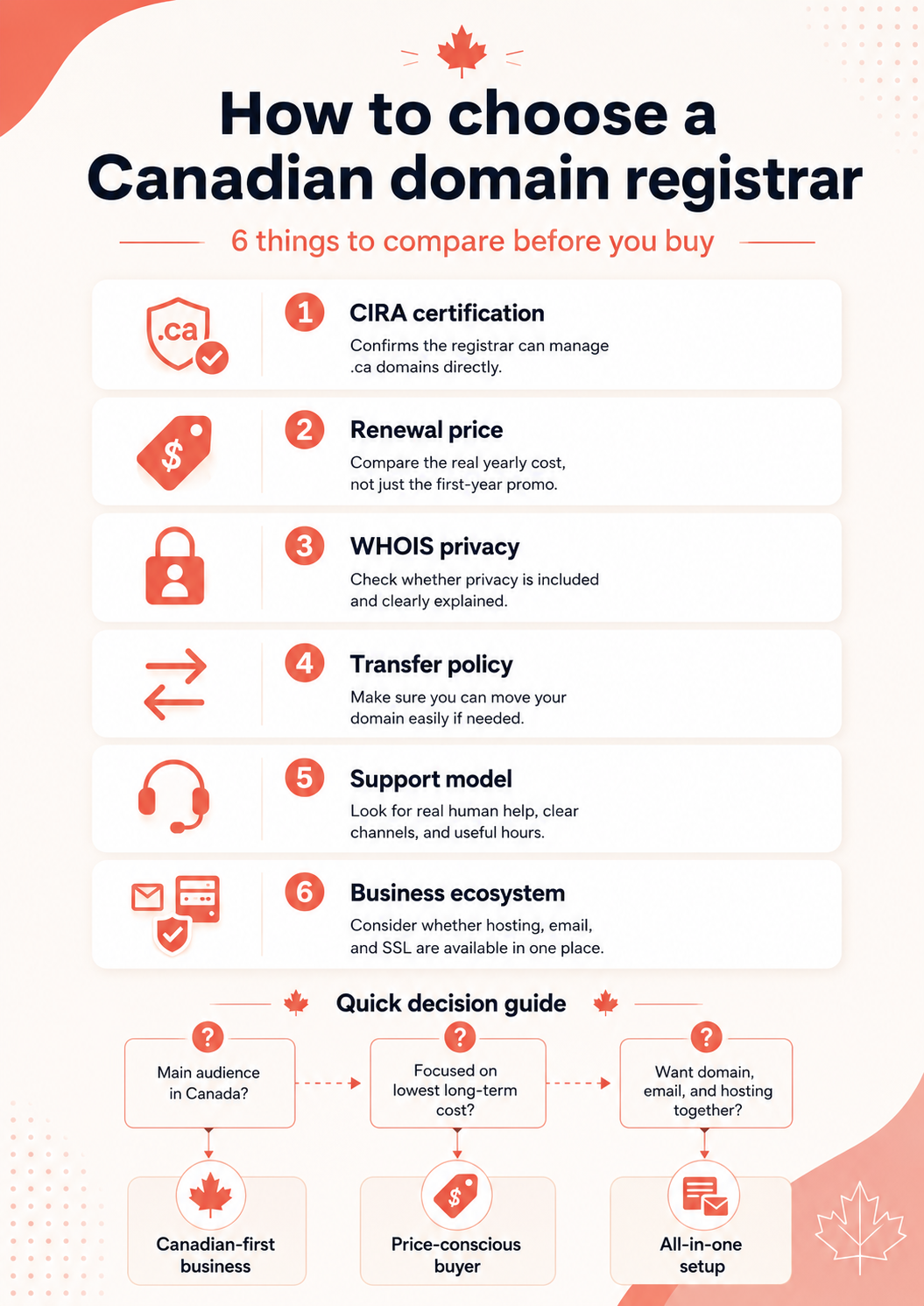
The best Canadian domain registrar for most small businesses is one that is CIRA-certified, transparent about renewal pricing, and based in Canada so support feels local when you need it most. Compare registrars on six things: CIRA certification, renewal price, WHOIS privacy, transfer policy, support model, and whether they can also handle hosting, email, and SSL. Price matters, of course, but the cheapest first-year deal can become surprisingly expensive in year two. A good registrar helps protect your name, your email, your SEO, and the trust people place in your business.
Table of contents
- Why your registrar choice matters more than people think
- What a domain registrar actually does
- The six criteria that actually matter
- Comparison table: how Canadian registrars stack up
- Red flags when shopping for a registrar
- Why a .ca-first registrar makes sense for Canadian businesses
- How Rebel fits the criteria
- Quick answer recap
- FAQ
Why your registrar choice matters more than people think
Your domain is not just a web address. It is the front door to your business, the anchor for your professional email, and a trust signal that appears every time someone sees your website, invoice, Google listing, or social profile. When the domain is working well, it quietly supports everything else you are building. When it is managed poorly, it can interrupt your website, email, search visibility, and customer confidence in one tidy little disaster sandwich.
Imagine a small business owner in Ottawa who registers a domain during a late-night burst of productivity. The first-year price looks great, the checkout is fast, and the website goes live without much fuss. A year later, the renewal price jumps, WHOIS privacy is no longer included, and a support ticket sits unanswered while email stops working for two full business days. The domain itself was cheap, but the disruption was not.
That is why choosing the best Canadian domain registrar is really about reducing future friction. You want clear pricing, easy transfers, reliable support, and policies you can understand before something goes sideways. Canadian businesses also have a few extra considerations, including .ca eligibility, Canadian support hours, currency, and data expectations. Those details are easy to overlook at checkout, but they matter once your domain becomes part of your daily operations.
What a domain registrar actually does
A domain registrar is the company that lets you register, renew, transfer, and manage your domain name. In plain English, it is your domain’s landlord, keyholder, and paperwork keeper all rolled into one. For .ca domains, CIRA manages the .ca registry, while certified registrars sell .ca domains and related services such as hosting. CIRA also notes that it does not sell .ca domains directly, which is why your choice of registrar matters.
Your registrar connects your domain to the systems that make your website and email work. It gives you access to DNS settings, renewal controls, contact records, transfer locks, and ownership details. If those tools are confusing, slow, or hidden behind support tickets, even a simple update can become stressful. If they are clear and supported by helpful humans, your domain quietly does its job in the background.
Canadian businesses face a different decision tree than many U.S. businesses. A .ca domain must meet Canadian presence requirements, and CIRA says applicants must have a connection to Canada to register and maintain a .ca name. That makes it especially useful to work with a registrar that understands .ca rules, Canadian business needs, and the practical realities of selling to Canadian customers.
The six criteria that actually matter
There are dozens of ways to compare registrars, but most small businesses do not need a 47-point spreadsheet and a fresh pot of coffee. You need a simple framework that separates real value from checkout-page sparkle. The six criteria below are the ones that tend to matter after the domain is already registered. They help you compare what you are really buying, not just what the first-year promo wants you to notice.
1. CIRA certification
CIRA certification matters because it shows that a registrar is certified to sell .ca domain names directly. CIRA’s registrar list explains that certified registrars sell domain names and related services, while CIRA itself manages the .ca registry. If you are building a Canadian business around a .ca domain, certification gives you a more direct relationship with the .ca ecosystem. It also makes support, policy questions, and transfers easier to understand.
An uncertified reseller is not automatically a problem, but it does add another layer. CIRA explains that some businesses may register through a reseller rather than a direct .ca registrar, and that WHOIS can help identify the registrar behind a specific domain. That extra layer can make support feel less direct when you need help quickly. For a business domain, simple and direct is usually the calmer choice.
2. Renewal price, not introductory price
The first-year price is the shiny sticker on the window. The renewal price is what you actually live with. Some registrars discount the first year heavily and recover that discount when the domain renews. That may be fine if you know it upfront, but it is less charming when the bill arrives by surprise.
For example, a registrar might sell a .ca domain at a low introductory price, then renew it at a higher standard rate the next year. Namecheap’s public pricing table shows .ca pricing with separate registration, renewal, and transfer columns, including a .ca renewal price listed separately from the first-year registration price. GoDaddy’s Canadian help page says customers can check renewal prices from inside their account by changing visible columns, which means the renewal amount may not be obvious from the general public pricing page. The safest habit is simple: compare the two-year cost, not just the year-one price.
3. WHOIS privacy included by default
WHOIS is the public lookup system connected to domain registration records. CIRA describes WHOIS as a directory service people can use to look up information about .ca domain names. Privacy matters because domain ownership records can include contact details, depending on the domain type, registrant type, and applicable rules. For many small business owners, clear privacy settings are part of feeling safe online.
When comparing registrars, check whether WHOIS privacy is included, restricted, or sold as an add-on. Namecheap states that it offers free privacy protection for life on many domains, but its own .ca row also notes that this TLD may require additional registration information. WHC states on its homepage that it includes free domain privacy, complete DNS control, domain locking, and 24/7 expert support for domains. The key is to understand what “privacy” means for the exact domain extension you are buying.
4. Transfer policy
A good registrar should make it clear how you can leave. Domains are portable, and you should be able to transfer your domain if your business needs change. The process should be documented, the fees should be clear, and the registrar should not make you feel like you are trying to sneak out of a hotel through the laundry room. A registrar that makes transfer information hard to find is asking you to trust them a little too much.
GoDaddy’s Canadian pricing page lists domain transfer pricing and says a domain transfer includes free registration for a year at C$17.99. Namecheap’s pricing table also separates registration, renewal, and transfer pricing, which makes comparison easier. Rebel’s domain pricing page says registration, renewal, and transfer details are presented together for clarity. That is the kind of structure small businesses should look for.
5. Support model
Support is boring until it is suddenly the most important thing in your day. When your domain stops pointing to the right website, or your email records need fixing, a helpful person in your timezone is worth more than a tiny discount. Look for support channels, hours, and language options. Also look for whether support is available by phone, chat, email, or only through tickets.
Rebel lists live chat, email support, and phone support on its domain pricing page, including a phone number for direct contact. WHC lists 24/7 expert support and provides phone and chat access on its homepage. Namecheap states that it offers 24/7 customer support on its domain pricing page. The best support model is the one that fits how you actually ask for help when the clock is ticking.
6. Ecosystem
A domain rarely travels alone. Most small businesses also need hosting, email, SSL, DNS, security, and sometimes a website builder. You can absolutely spread those services across different companies, but that often means more logins, more invoices, and more places to troubleshoot when something breaks. For many solopreneurs, one clear home for the essentials is easier to manage.
Rebel’s site describes a bundle that includes a domain, managed hosting, professional email, SSL, firewall, backups, malware protection, and expert support. WHC also offers hosting, managed WordPress, business email, SSL, domain protection, and domain privacy from the same ecosystem. Namecheap offers domains alongside hosting packages, coupons, DNSSEC, and related services. The right choice depends on whether you want a simple all-in-one setup or prefer managing separate providers yourself.
Comparison table: how Canadian registrars stack up
This table is designed to help you compare registrar fit, not crown a universal winner for every possible business. Pricing can change, and some registrars show renewal pricing only after a domain search or inside an account. The notes below use public information available as of May 20, 2026, and should be checked again before publication or quarterly refresh. For SEO and AI readability, publish this as an HTML table on the final page rather than as an image.
| Registrar | CIRA-certified | Head office / Canadian presence | .ca renewal pricing | WHOIS privacy | Transfer fee | Support channels | Hosting bundle |
|---|---|---|---|---|---|---|---|
| Rebel | Yes. Rebel displays “CIRA-certified Canadian registrar” and “ICANN accredited registrar” on its site. | Ottawa office listed at 532 Montreal Rd, Suite 261, Ottawa, Ontario. | Rebel brief lists .ca at C$11.99/year, same at renewal. | WHOIS lookup and domain protection options are available; confirm privacy setting by domain type before purchase. | Pricing page says registration, renewal, and transfer details are shown together. | Chat, email, and phone support listed. | Yes. Domain, managed hosting, professional email, SSL, backups, malware protection, and support are described in Rebel Bundle. |
| GoDaddy Canada | GoDaddy sells .ca domains and notes CIRA is the sponsor and backend provider for .ca. | Global registrar with Canadian site and Canadian pricing pages. | Public help page says renewal pricing can be checked inside the account. | Domain privacy and protection vary by product and domain type; confirm at checkout. | C$17.99 for domain transfer, including one year of registration. | Help centre and account-based support options. | Yes. Domains, websites, email, hosting, and web security are listed in pricing categories. |
| Namecheap | Offers .ca domains; confirm CIRA registrar status for the specific purchasing path before buying. | U.S.-based registrar. Namecheap identifies itself as U.S.-based on its site. | Public table lists .ca registration and renewal separately, with renewal shown as $14.98 in the visible pricing table. | Free privacy protection is promoted broadly, but .ca is marked as requiring additional registration information. | Public table lists .ca transfer pricing separately. | 24/7 support promoted on pricing page. | Yes. Hosting and package deals are promoted alongside domains. |
| WHC | Canadian .ca registrar; CIRA registrar status should be confirmed through CIRA’s registrar list before publishing. | Montreal office listed at 7250 Clark Street #301, Montreal, Quebec. | WHC help says domain pricing varies and renewal rates are shown in the Client Area. | Free domain privacy listed on homepage. | Transfer option listed; exact fee should be confirmed at checkout. | 24/7 expert support, phone, and chat listed. | Yes. Canadian web hosting, managed WordPress, business email, SSL, and domain services are listed. |
Red flags when shopping for a registrar
A registrar does not need to be flashy to be good. In fact, a calm, clear checkout experience is usually a better sign than a confetti cannon of discounts. The red flags below are worth checking before you register, renew, or transfer a domain. They do not always mean “walk away,” but they do mean “read the fine print before your business name gets comfortable there.”
- A renewal price that is much higher than the intro price. A first-year discount can be useful, but only when the renewal price is clear. Always calculate what you will pay over two or three years. If the registrar makes that hard, treat the discount with caution.
- WHOIS privacy sold as a confusing add-on. Privacy rules vary by domain extension, especially for .ca domains. Still, the registrar should explain what is included, what is restricted, and what costs extra. You should not have to become a policy detective to understand your exposure.
- No clear transfer-out policy. You should know how to unlock your domain, get an authorization code, and move your domain if needed. A registrar that explains transfers clearly is showing confidence. A registrar that buries the process may be making future flexibility harder.
- Support that only exists as a ticket queue. Tickets are fine for non-urgent questions, but domain and email issues can become time-sensitive. Small businesses often need live help when something breaks. Phone, chat, and responsive email support are practical advantages.
- Hidden admin fees or vague renewal language. Domain pricing should be plain. If the renewal amount, transfer cost, or add-on fees are unclear, keep looking. A registrar asking for your trust should earn it with visible numbers.
- A reseller layer you did not notice. Resellers can be legitimate, but they add a middle step. CIRA says WHOIS can help identify the actual registrar behind a .ca domain. If direct support matters to you, choose a CIRA-certified registrar where the relationship is easier to trace.
Why a .ca-first registrar makes sense for Canadian businesses
A .ca domain is more than a local-looking extension. It signals that your business has a Canadian connection, and CIRA’s Canadian presence rules help preserve that meaning. CIRA says .ca applicants must meet Canadian presence requirements, with eligible categories for individuals and organizations. For a business selling to Canadians, that local signal can make your website feel more familiar before someone reads a single word.
A .ca-first registrar understands those rules because they work with them every day. That matters when you are choosing between .ca and .com, registering both, updating ownership details, or moving domains during a rebrand. It also matters when your support request involves eligibility, WHOIS, DNS, or transfer timing. Local context helps turn domain management from “what fresh internet puzzle is this?” into a normal business task.
There is also a practical trust benefit. WHC displays a message that 86% of Canadians prefer .ca, and CIRA has long promoted .ca as a way to show Canadian identity online. Many Canadian businesses register both .ca and .com, then point one to the other. That approach protects the brand while letting the business lead with the extension that best matches its audience.
Canadian support can also make a difference. Time zones, billing currency, bilingual needs, and local business expectations all shape the support experience. A registrar with Canadian roots may be easier to reach during your working day. When your domain powers your email, website, and customer trust, that convenience is not a small thing.
How Rebel fits the criteria
Rebel is built for Canadian businesses that want domain management to feel clear, human, and connected to the rest of their online presence. Rebel’s site lists it as an ICANN-accredited registrar and a CIRA-certified Canadian registrar. It also lists an Ottawa office, which supports the local-first positioning that matters to many Canadian small businesses. The message is simple: your domain should be managed by people who understand where you are building.
Rebel also supports the bigger ecosystem around your domain. The Rebel Bundle includes a custom web address, managed hosting, professional email accounts, SSL, firewall, backups, malware protection, and expert support. That is useful for solopreneurs and small teams who would rather avoid juggling four providers, four invoices, and four support portals. One clear setup can be a relief when you would rather focus on customers than DNS records.
The support model is another practical strength. Rebel lists live chat, email support, and phone support on its domain pricing page. That combination gives small business owners options when they need quick answers or a real conversation. Domain problems can feel technical, but support should still feel human.
Rebel’s best fit is a Canadian business that wants local confidence, clear service options, and room to grow. You might be registering your first .ca, transferring a domain from another provider, or consolidating domain, hosting, email, and security under one roof. You do not need to become a domain expert to make a good decision. You just need a registrar that makes the important parts visible.
Quick answer recap
Choose a registrar that is CIRA-certified, clear on renewal pricing, honest about WHOIS privacy, easy to transfer from, and helpful in your timezone. The cheapest first year is rarely the whole story.
Decision flowchart: which registrar fits your business?
This visual would help readers turn the criteria above into a faster decision. The goal is not to force every business into the same answer. The goal is to help a reader recognize what they value most before they compare checkout pages. Use this as the concept for a simple infographic or interactive block on the page.
Flowchart copy:
- Are most of your customers in Canada?
If yes, prioritize a .ca domain and a CIRA-certified registrar. If no, consider registering both .ca and .com for brand protection. - Do you want domain, email, hosting, and SSL in one place?
If yes, choose a registrar with a strong business bundle. If no, choose the registrar with the clearest domain-only pricing and transfer controls. - Do you prefer local support?
If yes, prioritize Canadian offices, Canadian support hours, and phone or chat access. If no, make sure 24/7 support is genuinely available. - Are you comparing based on price?
If yes, compare the two-year or three-year cost, not the first-year discount. If no, weigh support quality, privacy, and simplicity more heavily.
Outcomes:
Best fit for Canadian-first small businesses: CIRA-certified, Canadian-based registrar with local support.
Best fit for bargain hunters: registrar with transparent multi-year pricing and included essentials.
Best fit for DIY operators: registrar with advanced DNS tools, clear transfer controls, and strong documentation.
FAQ
What makes a registrar “Canadian”?
A registrar can be considered Canadian in a few practical ways. It may be incorporated or headquartered in Canada, employ Canadian support staff, and serve Canadian customers in local time zones. For .ca domains, the most important operational factor is whether the registrar is certified by CIRA to sell .ca domains. CIRA’s registrar list exists specifically to identify companies certified to sell .ca domain names.
Is a .ca domain better than a .com for a Canadian business?
For businesses that primarily serve customers in Canada, a .ca domain is often a stronger local trust signal. It tells visitors that your business has a Canadian connection and is intended for a Canadian audience. A .com is still useful, especially for brand protection and international reach. Many Canadian businesses register both, then choose one as the main domain and redirect the other.
Can I switch registrars later?
Yes, domains are portable. You can move a domain from one registrar to another, usually by unlocking the domain, requesting an authorization code, and starting a transfer with the new registrar. Transfer fees and timing vary by registrar and domain type. Before you register, check whether the registrar clearly explains its transfer process and costs.
Why do renewal prices differ so much from registration prices?
Some registrars use low first-year pricing to make the initial purchase more attractive. The regular renewal price may be higher once the promotion ends. That does not automatically make the registrar a poor choice, but it does mean you should compare the full cost. Always look at the renewal price before you buy.
What does CIRA certification actually do for me?
CIRA certification means the registrar is certified to sell .ca domain names. CIRA manages the .ca registry, while registrars sell domains and related services to customers. For business owners, certification helps create a more direct path for .ca registration, management, and support. It also gives you a clearer way to confirm that your registrar is part of the official .ca ecosystem.
Conclusion: choose clarity now, thank yourself later
Your domain is one of the smallest business purchases you will make, but it supports some of your biggest assets. It affects your website, your email, your search visibility, and the way people recognize your brand. That is why the best Canadian domain registrar is not simply the one with the lowest first-year price. It is the one that keeps ownership, renewal, privacy, support, and growth simple.
For Canadian small businesses, a strong registrar should be CIRA-certified, transparent about renewals, clear about WHOIS privacy, and easy to contact when something needs attention. It should also give you room to grow into hosting, email, SSL, and security without turning your online presence into a drawer full of tangled cables. Rebel fits that need for businesses that want Canadian roots, real support, and a simpler way to manage the essentials. Your domain deserves a home that treats it like the business asset it is.