Best .ca registrar for small business: a Canadian buyer guide
Find the best .ca registrar for small business with clear pricing, CIRA certification, email, hosting, SSL, and human support.

A good .ca registrar should feel less like a maze and more like a friendly shortcut. For Canadian small businesses, the best .ca registrar for small business is one that bundles the domain with the things you’ll need anyway: professional email, hosting, SSL, and support. CIRA certification is the baseline. After that, the real difference is human help, predictable renewal pricing, and how quickly you can go from “I bought a domain” to “my business is live.”
Table of contents
- Why small businesses need a different kind of .ca registrar
- What “best” really means for a small business
- The 5 questions to ask before buying a .ca domain
- Bundles vs. à la carte: which one makes sense?
- What a small business actually needs in year 1
- How Rebel approaches the small-business buyer
- FAQ
Why small businesses need a different kind of .ca registrar
A small business does not buy a domain the same way a hobbyist or enterprise team does. A hobbyist might be fine experimenting with five tools, three dashboards, and a few “future me will figure it out” decisions. An enterprise has procurement teams, IT departments, and someone whose job title includes the word “infrastructure.” A small-business owner usually has a coffee, a calendar full of customer work, and about 17 minutes before the next thing catches fire.
That is why the best .ca registrar for small business is not always the registrar with the flashiest first-year discount. It is the registrar that helps you get online faster, keeps your costs clear, and gives you support when something confusing happens. CIRA manages the .ca domain as Canada’s country-code top-level domain, and .ca registrants must go through CIRA-certified registrars rather than registering directly with CIRA.
Small businesses are also more sensitive to renewal surprises. A $3 first-year deal can look charming until the second-year price, privacy add-on, email bill, SSL cost, and hosting renewal all arrive separately. For a founder trying to forecast cash flow, that is not a tiny inconvenience. It is another spreadsheet goblin, and frankly, you have enough of those.
Credibility also matters earlier for small businesses. A matching website and email address can change how people perceive you before they ever talk to you. hello@yourbusiness.ca feels more established than a free personal inbox, especially when paired with a clean site and secure connection. Rebel describes this same small-business need across its domain, hosting, email, and security products, with professional email, hosting, SSL, and support positioned as connected parts of getting online.
What “best” really means for a small business
For a small business, “best” should mean practical, not fancy. The right registrar should help you move from domain purchase to working website and branded email with as little friction as possible. That means fewer logins, fewer invoices, fewer mysterious settings, and fewer moments where you are Googling DNS acronyms at 11:43 p.m. The ideal experience is simple enough for a founder to manage without becoming the accidental IT department.
Here is what matters most when choosing a small business domain in Canada. Each point looks simple on the surface, but together they separate a cheap domain checkout from a registrar that can actually support your business as it grows.
- Speed to live: A domain is only useful once it points somewhere. The best registrar should make it easy to connect your .ca domain to a website, hosting, and email quickly. For many small businesses, the practical goal is not “own a domain.” The practical goal is “customers can find me, trust me, and contact me today.”
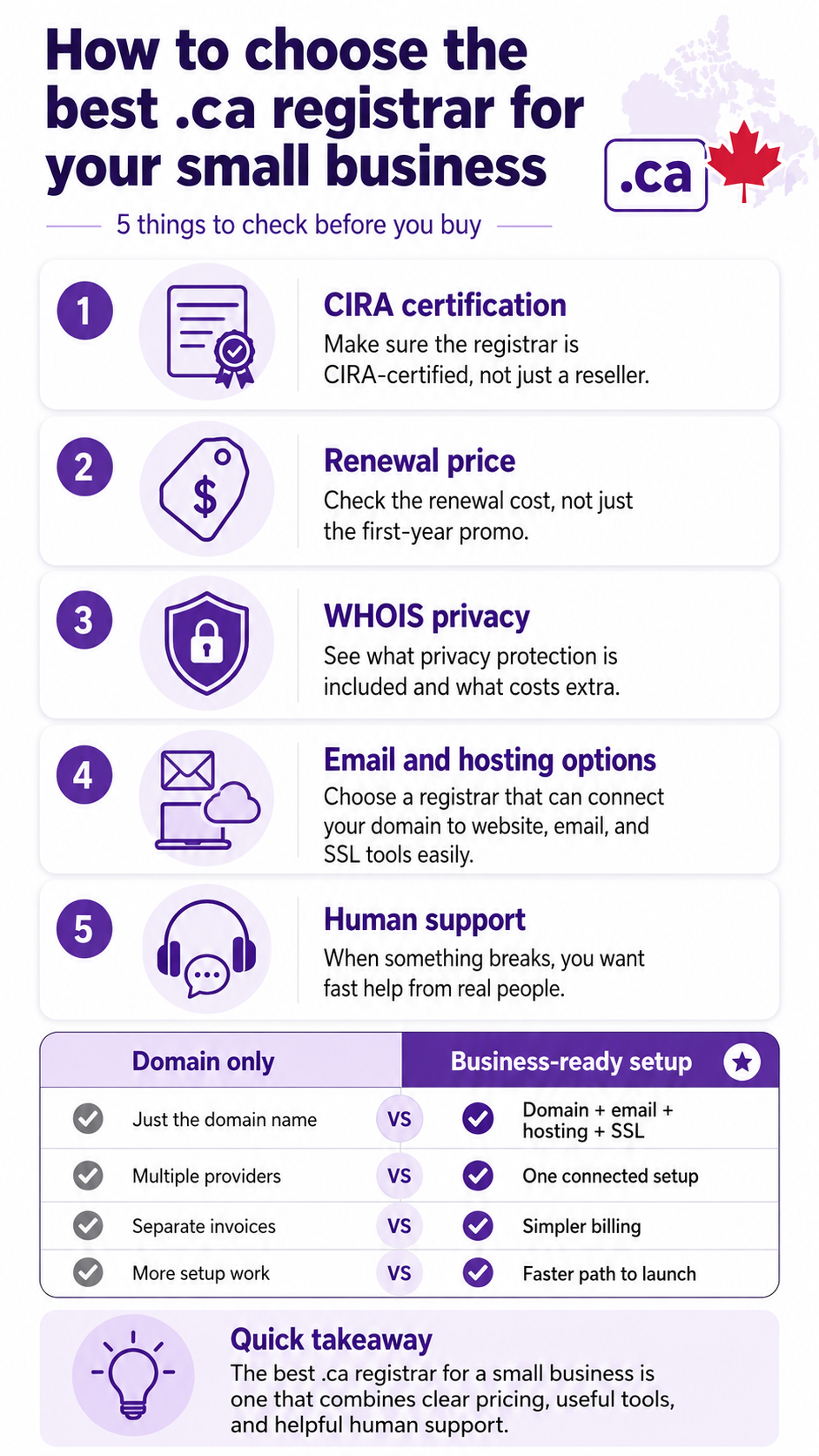
- One invoice instead of four: Separate providers can work well, but they also create extra admin. You may end up with one bill for the domain, one for email, one for hosting, and one for SSL or security. That can be fine for a technical team. For a small business, fewer renewals and one clear billing date can be a real operational win.
- Support that explains, not deflects: Domain issues often involve multiple systems. Your registrar might blame your host, your host might blame your DNS, and your DNS might quietly sit there being DNS. A strong registrar helps you understand what is happening and what to do next. Rebel’s support pages highlight live chat, email support, and phone support availability, including real-human chat support from 8 a.m. to 10 p.m. EST daily.
- Renewal predictability: The first-year price matters, but renewal pricing matters more. A founder planning annual expenses needs to know what the domain will cost next year, not just today. Rebel’s domain pricing page emphasizes showing registration, renewal, and transfer pricing clearly in one place.
- Canadian relevance: A .ca domain tells Canadian customers that you are local, relevant, and easier to recognize. CIRA describes .ca as a unique identifier for Canadian websites and requires registrants to meet Canadian Presence Requirements. For businesses selling mainly in Canada, that local signal can support trust before a visitor reads a single sentence.
The 5 questions to ask before buying a .ca domain
Buying a .ca domain should not feel complicated, but a few careful questions can save you from messy migrations later. This is especially true if your website, email, and domain will become the front door of your business. The domain is not just a name. It is the anchor for your website, your email, your search presence, and your customer trust.
Ask these five questions before you choose your registrar. They will help you compare options clearly and avoid being distracted by a low first-year price that does not reflect your actual year-two cost.
- Is the registrar CIRA-certified, or are they a reseller? CIRA-certified registrars are authorized to register, renew, transfer, and update .ca domain registrations. That matters because only certified registrars can apply to CIRA for .ca registrations and related transactions. A reseller may still be legitimate, but you should know who ultimately controls the registration relationship.
- What is the renewal price, written down? The registration price is the first chapter, not the whole story. Look for renewal pricing before you buy, not after the domain is already attached to your brand. A registrar that makes renewal pricing easy to find is doing you a favour. A registrar that hides it is asking you to trust a fog machine.
- Does it include WHOIS privacy, or is that extra? WHOIS privacy protects contact details from being easily scraped or misused. CIRA notes that individual .ca registrants have contact information withheld from public WHOIS by default, which means individuals do not need to buy extra privacy protection for that purpose. Businesses should still review how their information is displayed and what privacy or protection options are available.
- Can I add email and hosting without re-registering anywhere? Your domain is usually the first piece, but it is rarely the last. Most small businesses also need branded email, hosting, SSL, and basic security. Choosing a registrar that can support those next steps reduces setup friction. It also gives you one place to ask for help when the pieces need to work together.
- If something breaks at 9 p.m. on a Tuesday, who helps? This is not dramatic. This is small-business life. A broken website, email issue, or DNS mistake can cost real leads. Rebel lists live chat availability from 8 a.m. to 10 p.m. ET daily and email support 24/7, which is the kind of coverage small businesses should compare when choosing a registrar.
Bundles vs. à la carte: which one makes sense?
There are two main ways to buy your domain setup. You can bundle the essentials with one provider, or you can buy each piece separately from different providers. Neither approach is automatically better for everyone. The right answer depends on how technical you are, how much time you have, and whether your business already has tools in place.
For most very small teams, a bundle is the smoother option. If you are under 10 employees, do not have IT support, and want one invoice, a bundle can remove several setup decisions at once. You get the domain, website tools, email, hosting, SSL, security, and support working as a connected setup. Rebel’s homepage positions the Rebel Bundle around this exact category need, including an AI Website Builder, professional domain, managed hosting, pro email accounts, built-in security, and expert support.
À la carte makes sense when you already know your preferred stack. Maybe you are already using Google Workspace, already have a developer, or already host your website somewhere specific. In that case, buying only the .ca domain from a registrar and connecting it elsewhere can be completely reasonable. Just make sure the registrar gives you clean DNS controls, clear transfer rules, and support that does not disappear when your domain connects to a third-party service.
Here is a simple cost comparison to frame the decision. The exact numbers will change by plan and provider, so treat this as a planning model rather than a universal quote. The point is to compare the total setup cost, not just the domain line item.
| Year 1 need | Bought separately | Bundle approach |
|---|---|---|
| .ca domain | Around $11–$20 | Included or billed clearly |
| Branded email | Monthly per mailbox | Often included or easier to add |
| SSL | Free with some hosting, paid with others | Often included with hosting/security |
| Hosting or site builder | Monthly or annual plan | Included in one setup |
| Support | Split across providers | One place to contact |
| Billing | Multiple renewal dates | One renewal path |
For a small-business owner, the hidden cost is time. If buying separately saves $20 but costs three evenings of setup frustration, it may not be the cheaper option. If buying separately gives you the control you actually need, then it may be worth it. The best decision is the one that fits your business stage, not the one that wins a spreadsheet beauty contest.
What a small business actually needs in year 1
Your first year online does not need to be overbuilt. You do not need a giant tech stack, a custom app, or a dashboard that looks like it escaped from mission control. You need the basics done well. Once your foundation is solid, you can add more tools as your business grows.
A practical year-one setup should include these essentials. Each one supports trust, discoverability, or day-to-day operations, which is exactly what a small business domain Canada strategy should do.
- A .ca domain: Start with the name your customers will remember. If your customers are primarily Canadian, .ca gives you a local trust signal from the first click. It also helps protect your brand in the Canadian market. If the matching .com is available, consider registering it too and redirecting one version to the other.
- Professional email at your domain: Branded email makes your business feel more established. It also keeps business communication separate from personal inboxes, which helps with organization and trust. Rebel offers professional email options and positions branded addresses as part of making a strong first impression.
- SSL security: SSL is the padlock visitors expect to see in the browser. It protects data in transit and signals that your site is safer to use. Rebel’s hosting page states that hosting plans include SSL, a built-in firewall, malware scanning, backups, and two-factor login.
- Basic hosting or a site builder: Your domain needs somewhere to point. A simple website can be enough in year one if it clearly explains what you do, who you serve, and how to contact you. Rebel’s bundle includes an AI Website Builder, managed hosting, and guided setup, which can help founders who do not want to design from scratch.
- Domain privacy and protection: Review what privacy is included and what protection options are available. For individual .ca registrants, CIRA states that contact information is not displayed on .ca WHOIS by default. Business registrants should still understand their exposure and choose protection that fits their situation.
- Auto-renewal: Domains are small assets with big consequences. Forgetting to renew can disrupt your website, email, and brand presence. Rebel’s renewal help article explains that automatic renewal attempts begin 45 days before expiry and that additional billing attempts happen if the first one fails.
How Rebel approaches the small-business buyer
Rebel is especially strong for the small-business buyer because the positioning matches the actual problem. Most founders are not shopping for a domain in isolation. They are trying to look legitimate, get found, receive email, protect their site, and move on with their day. That makes the best .ca registrar for small business the one that connects the pieces without making you become fluent in backend chaos.
Rebel’s small-business advantage is the connected setup: domain, site, email, security, and support in one place. The Rebel Bundle includes a professional domain, AI Website Builder, managed hosting, pro email accounts, security, and expert support. That structure is useful because it treats the domain as the start of your online presence, not the end of the checkout.
Support is another meaningful differentiator. Rebel got its start in Ottawa and describes itself as built in Canada for people building something real. Its support pages list real-human support channels, including chat, email, and phone availability. For a founder who is also the IT department, that support is not a side feature. It is part of the product.
Pricing clarity also matters. Rebel’s pricing page is built around showing registration, renewal, and transfer pricing in one place. For the .ca small-business buyer, that matters more than a bargain-bin first year. A predictable renewal is easier to plan, easier to approve, and easier to explain to future you, who will appreciate fewer billing surprises.
The opinionated take is this: if you are a Canadian entrepreneur starting from scratch, choose a CIRA-certified registrar that can also help you launch the working parts around the domain. If you already have an established tech stack, à la carte may be fine. But if your goal is to get live quickly with a .ca domain, branded email, hosting, SSL, and helpful support, Rebel is a very natural fit for the small-business segment.
FAQ
What is the cheapest .ca registrar?
The cheapest .ca registration price is often around $11–$13, depending on promotions and registrar pricing. But cheapest registration does not always mean cheapest registrar. You should compare renewal pricing, transfer pricing, privacy features, support quality, and whether email or hosting will cost extra. A low first-year price can be useful, but a predictable long-term cost is usually more important for a small business.
Can I register a .ca without a Canadian address?
You need to meet CIRA’s Canadian Presence Requirements to register a .ca domain. Common eligibility categories include Canadian citizen, permanent resident, Canadian corporation, Canadian trademark holder, association, partnership, educational institution, hospital, and government. CIRA notes that registrants may be asked to provide proof through Registrant Information Validation. If your business is not clearly eligible, check the CIRA requirements before building your brand around a .ca name.
Do I need a .ca if I already have a .com?
If your customers are mostly Canadian, a .ca is usually a smart move. It gives your business a local trust signal and helps customers understand that you serve the Canadian market. Many businesses register both the .ca and .com versions of their name, then redirect one to the primary website. That protects the brand and reduces confusion if customers type the other extension.
Should I buy hosting from the same place as my domain?
You do not have to buy hosting from the same company as your domain registrar. However, doing so can reduce setup friction and give you one place to contact when something breaks. The trade-off is that you should make sure the provider keeps domain controls clear and makes leaving easy if your needs change. For many small businesses, the convenience of one provider is worth it in year one.
Conclusion: choose the registrar that helps your business show up
The best .ca registrar for small businesses is not just the one that sells you the domain. It is the one that helps you turn that domain into a working online presence with less friction, clearer billing, and support that feels human. CIRA certification should be your baseline. After that, compare renewal pricing, email, hosting, SSL, privacy, and the quality of help available when your setup needs attention.
For Canadian small businesses, Rebel is a strong fit because it understands that the domain is only step one. The real goal is getting your business online with a professional website, matching email, built-in security, and support from people who can explain what is happening. That is exactly where a small business needs the most help. Your domain should make you look more ready, not give you more admin homework.